Ponder
Practical Movement Frameworks

Structured Mobility & Posture Programs

Consistent movement frequency consistently outperforms sporadic bursts of high-intensity exertion. Our educational programs are modular, equipment-free, and designed to seamlessly integrate into demanding work and life schedules.

Ergonomic desk workspace and posture alignment
Workplace Ergonomics

Desk Posture & Spinal Decompression

Designed for professionals spending extensive hours seated in front of digital displays. This protocol systematically breaks static postural inertia, reversing the classic forward head posture and kyphotic thoracic rounding.

Key Program Progression:

  • Block 1 (4 mins): Cervical retraction and suboccipital glide against chair backrest.
  • Block 2 (4 mins): Seated thoracic extension and rotational open-book reach.
  • Block 3 (4 mins): Standing hip flexor opening and isometric scapular squeezes.

Outdoor cadence walking and natural movement
Gait Dynamics

Functional Cadence & Stride Protocol

Walking is humanity's foundational endurance mechanism. This program teaches you to synchronize stepping rhythm, maintain an upright kinetic axis, and utilize foot arches as natural shock absorbers.

Key Program Progression:

  • Block 1 (3 mins): Ankle dorsiflexion rocks and plantar fascia rolling.
  • Block 2 (14 mins): Steady cadence walk maintained at 112–118 steps per minute.
  • Block 3 (3 mins): Post-walk soleus and gastrocnemius lengthening against a curb.
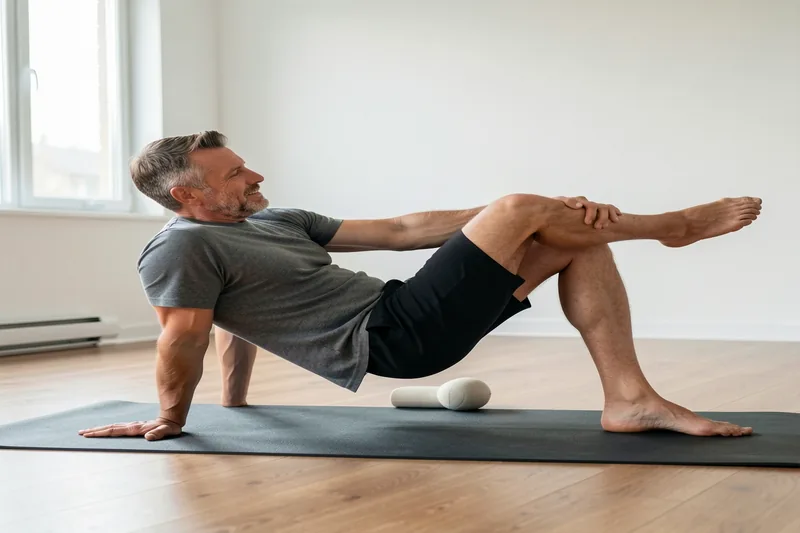
Hip joint mobility and pelvic alignment floor routine
Pelvic & Joint Health

Pelvic Rhythm & Hip Mobility Flow

Continuous seated posture causes adaptive shortening of the psoas and rectus femoris while inhibiting gluteal activation. This mat sequence restores multidirectional hip socket freedom and pelvic balance.

Key Program Progression:

  • Block 1 (5 mins): Grounded 90/90 hip transitions and active internal rotation.
  • Block 2 (5 mins): Half-kneeling pelvic tucks with posterior tilt engagement.
  • Block 3 (5 mins): Quadruped hip circles (CARs) with neutral spine stability.
Quiet evening restorative decompression and restful environment
Restorative Decompression

Evening Kinetic Decompression & Sleep Hygiene

Physical recovery occurs primarily in deep non-REM sleep. This soothing evening sequence gently tractionates the lumbar spine, down-regulates sympathetic nervous activity, and sets up restorative sleep hygiene.

Key Program Progression:

  • Block 1 (3 mins): Legs-elevated supine rest with gentle lower back flattening.
  • Block 2 (4 mins): 4-7-8 diaphragmatic pacing for parasympathetic signaling.
  • Block 3 (3 mins): Passive spinal twist with lateral chest expansion.

Principles for Sustainable Movement Practice

1. Respect the Mechanical Edge

Mobility training is an exploration of controlled motor control, not a contest of strain. Move smoothly to the point of gentle resistance, breathe rhythmically, and avoid forcing end-range positions.

2. Consistency Compounds Linearly

Ten minutes practiced every single day yields vastly greater neurological adaptation and connective tissue elasticity than a single ninety-minute weekend session.

3. Contextual Individualization

Every skeletal anatomy has unique femoral neck angles and spinal proportions. Tailor angles and ranges to what feels organic within your individual joint articulation.

Have questions about integrating these protocols into your daily schedule?

Speak with the Editorial Desk